
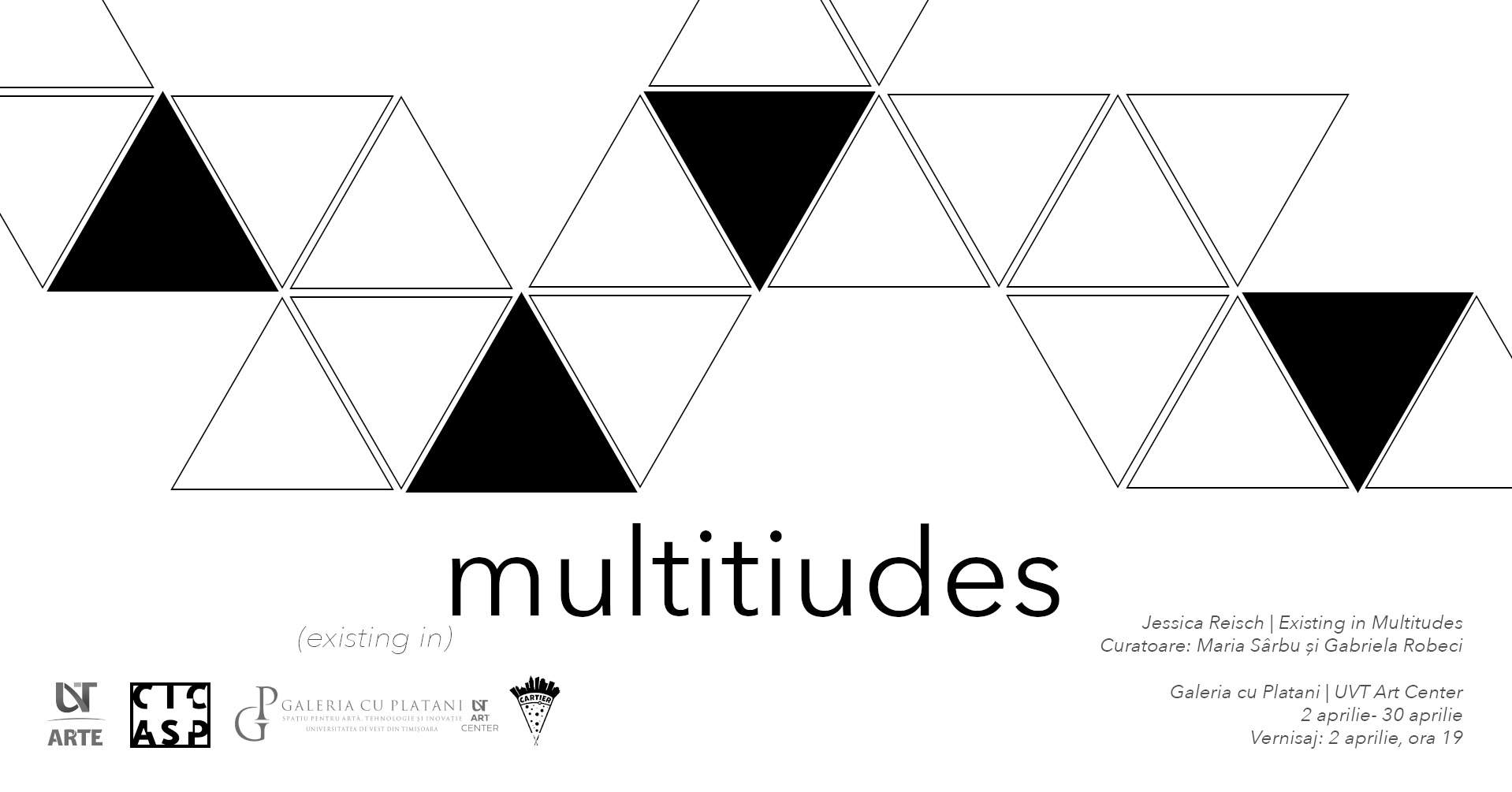
Artist Jessica Reisch, trained in New York in the fields of new media and design and active on the international scene, presents at the Platani Gallery – UVT Art Center an exhibition that brings together two recent projects, Existing in Multitudes (2026) and Primordial Attending (2026), in a dialogue about alternative ways of understanding the relationships between living entities.
The two projects share a critical approach to dominant anthropocentric perspectives. The artist proposes a shift from hierarchical structures towards more interconnected and decentralized models.
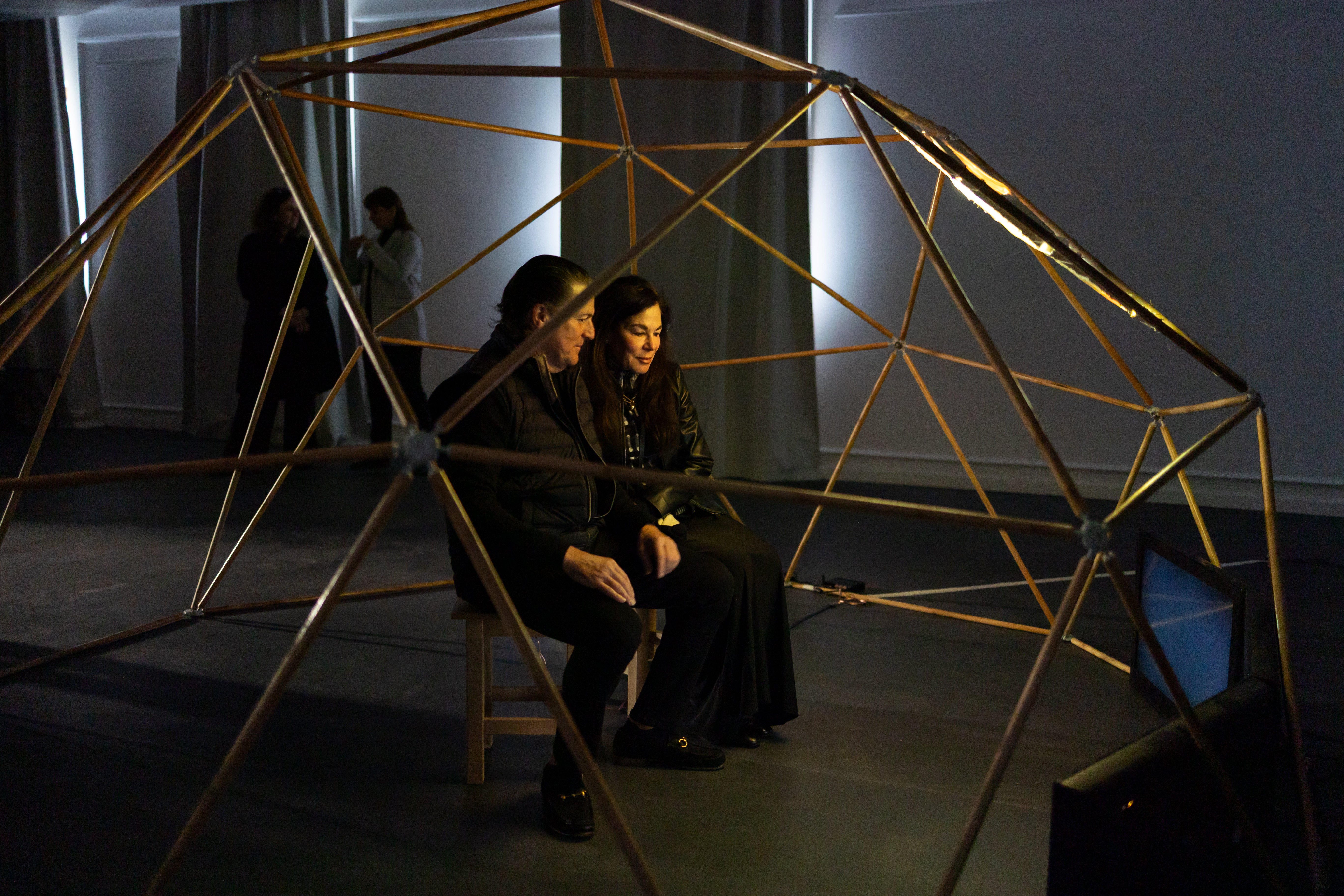
Photo Credit: Razvan Sogor, 3rd year B.A. in Photography & Videography, Faculty of Arts and Design, West University of Timisoara
Video Credit: Marius Mot, 2nd year, M.A. in Photography & Videography, Faculty of Arts and Design, West University of Timisoara
Existing in Multitudes draws on biological research on tunicates to question the idea of evolution as linear progress. The rhizomatic structure of the geodesic dome, along with the living mycelium surfaces that partially cover it, symbolically represent alternatives to this type of hierarchical ladder.
At the same time, Primordial Attending explores the temporal and ecological layers of the Summer Lake region in Oregon, reflecting on the coexistence between human and non-human entities.
Together, the two works create a shared framework for reflecting on the interdependence between species, living materiality, and the ways knowledge about the living world can take on poetic and meditative dimensions.
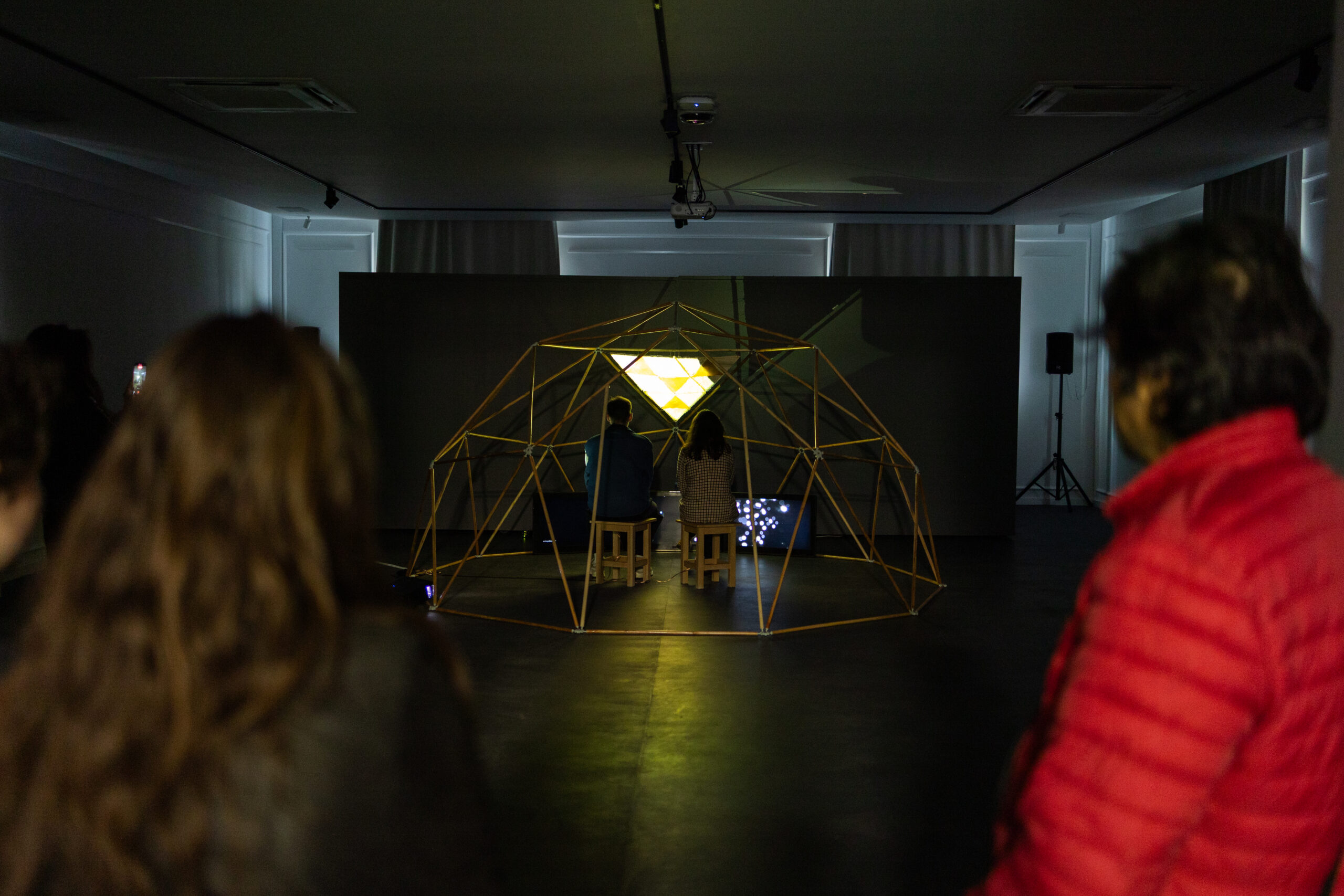
Photo Credit: Razvan Sogor, 3rd year B.A. in Photography & Videography, Faculty of Arts and Design, West University of Timisoara
Video Credit: Marius Mot, 2nd year, M.A. in Photography & Videography, Faculty of Arts and Design, West University of Timisoara
Existing in Multitudes (2026) is a multimedia, geodesic dome installation that draws on comparative biologist Andreas Hejnol’s research on tunicates (sea squirts) as disruptors of the apical notion of evolution as a linear movement from “simple” to “complex”.
From Aristotle’s Historia Animalium to Charles Darwin’s iconic tree of evolutionary relationships, hierarchical arrangements of organisms have contributed to an anthropocentric perspective on beinghood. On the imagined evolutionary ladder, sea squirts would be at the lowest rungs, thought to be our most distant and “primitive” relatives. However, studies within the last decade have revealed that these filter-feeders are more closely related to vertebrates (including humans) than organisms with more complex morphological characteristics.
As an alternative to the hierarchical ladder, the geodesic dome is a rhizomatic structure through which we may re-conceptualize understandings of life. Dome shapes have a significant history in Indigenous cultures as forms of shelter and ceremonial spaces, and the geodesic dome was popularized in the United States in the mid-twentieth century by Buckminster Fuller as a prototype for a radical housing model.
Within the geodesic dome structure, a mosaic of mycelium and bacterial cellulose material serve as a projection surface. Microscopy footage of sea squirts and fungi are projected onto the organic surfaces, offering a place to look for evolutionary insights and alternate ways of being.
Primordial Attending (2026) is a three-channel, experimental film that explores the timescales around Summer Lake in Lake County, Oregon, USA. Historical and contemporary research, site-specific footage, and poetry from three artists (Amanda Lichtenberg, Eric Magrane, and Jolie Kaytes)* are combined with a soundscape created from field recordings taken within the alkaline waters of Summer Lake and the fissured cracks of the mudflats known as the playa. Writing and recording was completed at PLAYA Summer Lake Artist Residency.
Summer Lake is a remnant of the ancient Lake Chewaucan, from the Pleistocene era, ~13,000 years ago. Pleistocene-era waves also created the nearby Paisley Caves, where there is archaeological evidence of the oldest definitively-dated human presence in North America. The Northern Paiute people are their descendants, and the original stewards of this ancient lakebed. Though it remains one of the least-known in the history of the genocidal war on Indigenous people, the deadliest conflict in the American West was the war on the Northern Paiute from 1864–1868, on territory that includes modern-day Lake County.
Today, Summer Lake receives a seasonal influx of water from the Ana River, which is increasingly diverted to irrigate Lake County’s growing agricultural focus on alfalfa hay. Christmas Valley in Lake County exports the most alfalfa hay in the region, reaching an international market. The bright-green crop grows in stark contrast to the high-desert’s natural landscape, threatening the ecosystem’s future.
A thousand days in these days.
…
“Here” is also a distance.
Meaning I’m farther from myself today, or I’m getting closer.
(“September Something” Amanda Lichtenberg)
Think “go with your gut” and repeat after me:
I am mostly microbial flora.
(Eric Magrane)
A playa
…
marked by an ephemeral lake,
collects the undoings of mountains.
(Jolie Kaytes)
Jessica Reisch is a new media artist, designer, and educator with an MFA in Computer Arts from the School of Visual Arts (SVA) in New York City, and a BA in Education Studies from Brown University in Providence, Rhode Island, USA. She has taught digital design, media, and emerging technology courses at Pratt Institute, New York Institute of Technology (NYIT) and Hostos Community College (CUNY) in New York City, USA. She is also the recipient of a 2025-2026 Fulbright ETA Award to teach at the West University of Timisoara, in Romania.
Through her practice she explores the surrounding environment with a depth usually overlooked or barely perceived by humans and investigates modes of perception that extend beyond human-centered experiences, inviting more profound forms of attention and relational awareness.
Her installations and films have been shown internationally, including at Ars Electronica (Linz, Austria), Locust Projects (Miami, FL), The Engine Room International Sound Art Competition (London, UK), SIGGRAPH 2024 (Denver, CO), and the International Symposium on Electronic Arts (ISEA) 2024 (Meanjin/Brisbane, Australia).